Data Center Physical Security: Layers, Controls, and Best Practices
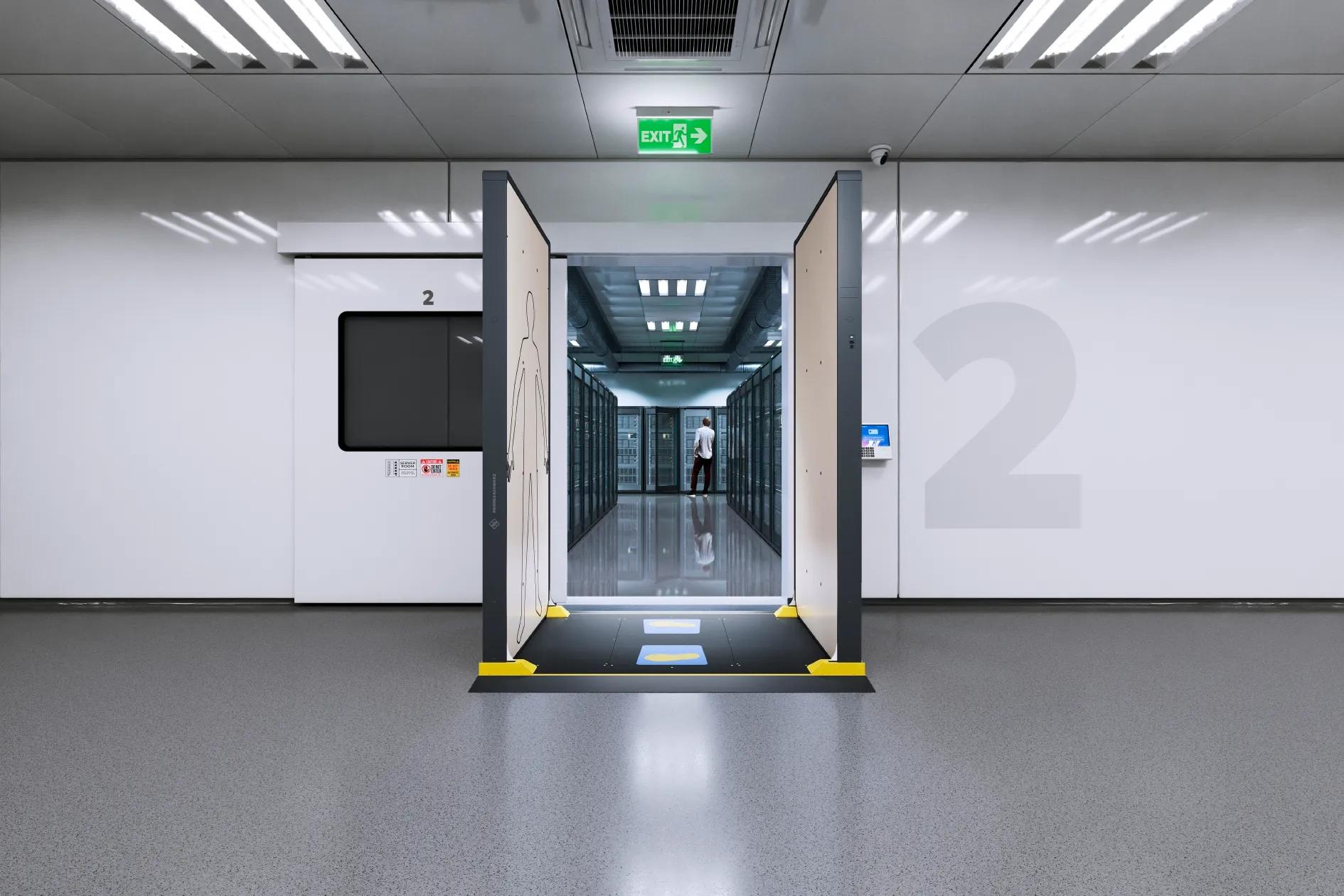
A data center can run flawless encryption, redundant firewalls, and a round-the-clock security operations center, and still be compromised by one unbadged visitor who slips through a side door, or one contractor who plugs an unauthorized device into a server rack. If someone can gain unauthorized physical access to your server environment, even the strongest cybersecurity architecture can be put at risk.
For data center operators, physical security isn't a box to check once during construction and revisit at the next audit. It's a layered, ongoing system that protects uptime, supports compliance, and underpins the trust your clients place in you to safeguard their infrastructure. That's the lens we bring to data center security at Securitas Technology: not a single control, but a system that has to keep working every hour of every day.
This guide walks through what data center physical security means, why it demands attention now, the layers that make up a defense-in-depth approach, the standards shaping today's requirements, and a practical checklist you can use to evaluate where your facility stands.
Key Takeaways
- Data center physical security works in layers, from the property perimeter down to individual racks, with each layer assuming the one before it could fail.
- Employee safety, not just equipment protection, is now the top-cited driver of security investment: 30% of respondents rank it their single most important priority.
- Compliance frameworks including TIA-942, ISO 27001, SOC 2, and NIST 800-53 all touch physical security, and audits routinely test it.
- Environmental and infrastructure failures are expensive: 57% of major outages now cost over $100,000, and 1 in 5 exceed $1 million.
- Visitor, vendor, and contractor access is the most common gap in an otherwise well-built system.
What Is Data Center Physical Security?
Data center physical security is the combination of people, technology, and policy that protects a facility's physical infrastructure from unauthorized access, theft, sabotage, and environmental threats. It covers everything from perimeter fencing and building entry to the locks on an individual server cabinet.
It's easy to treat physical security and cybersecurity as separate disciplines with separate budgets and separate teams. In practice, they increasingly overlap. A compromised access-control device can create a way into connected security infrastructure, while unauthorized physical access can expose network equipment that cyber controls were designed to protect. An unmonitored loading dock is a data breach waiting to happen. The two protect the same asset from different directions, and effective data center security treats them as a single, coordinated program.
At its core, data center physical security is built to prevent three categories of harm: unauthorized access to spaces where sensitive infrastructure lives, theft or sabotage of equipment and data, and disruption from environmental or natural events: fire, flooding, power failure, extreme temperature. Every layer of control discussed in this guide, from perimeter fencing to rack-level locks, exists to address one or more of these threats.
Why Data Center Physical Security Matters Now
Security technology investment is accelerating, and the reasons behind it are shifting. In our Global Technology Outlook Report 2026, employee safety emerged as the single most-cited driver of that investment. Thirty percent of respondents rank it their single most important priority1. For a data center, that means physical security decisions aren't just about protecting servers; they're about protecting the people who badge in every day to keep those servers running.
At the same time, the line between physical and digital risk keeps blurring. As Mike Beattie, Securitas Technology CIO, puts it, “For any organization, protecting confidential data has become equally as important as protecting people, property, and assets. Security technology now sits at the intersection of physical and cyber risk, and organizations must manage both simultaneously.”2 A data center is where that intersection is most literal: the equipment behind a locked cabinet door is the same equipment a cyberattack would target from the network side. We look at how data center physical security intersects with cybersecurity in a companion piece, but the short version is this: a facility with strong network security and weak door security has one strong wall and one open one.
For operators managing mission-critical infrastructure, that combination (rising expectations around employee safety and tightening physical-cyber convergence) is why physical security now belongs on the same strategic roadmap as your network architecture, not a line item revisited only after an incident.
The Layers of Data Center Physical Security
The most effective data center security programs are built in layers: an “outer in, inner out” approach where each layer assumes the one before it could fail. A lapse at the perimeter shouldn't mean unrestricted access to the server hall, and a badge failure at the building door shouldn't mean unrestricted access to an individual rack. We explore this model in more depth in The Layers of Data Center Physical Security, but here's how it typically breaks down.
Perimeter Security
The outermost layer establishes the boundary of the property itself: fencing, vehicle barriers, controlled gates, and perimeter lighting designed to deter and delay before anyone reaches a building entrance. Perimeter intrusion detection (sensors on fence lines, LiDAR, radar, thermal cameras, robots and drone surveillance) extends that boundary into something actively monitored rather than passively fenced.
Airspace is an increasingly common addition to this layer. Drone activity near a data center campus can mean anything from casual curiosity to deliberate surveillance of your security procedures, and drone detection technology (combining radio frequency sensors, radar, and video) is increasingly considered for high-risk/critical sites.
Building & Facility Access Control
The next layer governs who can enter the building at all. This is where mantrap entries (a small vestibule with two interlocking doors designed to help control passage) are commonly deployed at higher-security facilities, alongside visitor processing, credential verification, and staffed or monitored reception points. Anti-tailgating detectors (ATGs) add another check at entry and exit doors, using sensors beyond cameras to count people passing through and compare that count with the corresponding badge or biometric reads. This helps detect situations where a valid credential is used but more than one person passes through. Every entry event should be logged, not just permitted: knowing who came in and when matters as much as deciding who's allowed to.
Server Hall / Data Hall Security
Inside the building, the server hall or data hall (often called the server room) is typically where badge-based access control and biometric verification converge. This is a second credential check beyond the building entrance, often paired with video analytics that can flag unusual behavior in real time rather than relying on someone manually reviewing footage after the fact. AI-driven video analytics is now the single most-cited technology investment priority looking ahead, named by 21% of market survey respondents as their top pick for the next 12 to 18 months3. For a data center, that shift matters because analytics can detect or flag conditions that a person monitoring dozens of camera feeds might miss: someone lingering near a rack row, a door propped open, a pattern that doesn't match normal shift activity. We've covered how AI is improving data center security elsewhere; the practical takeaway here is that video surveillance in the server hall should be treated as an active detection tool, not passive recording.
Server Rack / Cabinet-Level Security
The innermost layer protects individual racks and cabinets: the equipment itself, not just the room around it. Cabinet-level locks, tamper alerts, and discrete per-rack monitoring mean that even someone who has legitimately entered the server hall, like a contractor or vendor technician, doesn't have unrestricted access to every client's equipment inside it. In multi-tenant and colocation facilities especially, rack-level controls are often what separates one client's compliance posture from another's within the same room.
Some data center providers also install cameras inside server cabinets, positioned to capture a face-level view of the person opening the door. This adds a visual record at the point of equipment access, complementing cabinet locks, tamper alerts, and access logs rather than relying only on cameras covering the surrounding room.
Environmental & Infrastructure Controls
Physical security only protects a facility that's still standing and running. Fire suppression, flood and moisture sensors, and continuous temperature and humidity monitoring guard against the environmental threats (water damage, extreme heat, fire) or infrastructure failures that can take a data center offline as surely as an intruder can. The stakes are quantifiable: 57% of organizations say their most recent major outage cost more than $100,000, and for the second consecutive year, 1 in 5 report costs exceeding $1 million7. These controls belong in the same layered, continuously monitored framework as the access and surveillance layers above, not treated as a separate facilities concern.
Layered together, these controls track closely with how the industry is actually investing today. Across a 2027 global client survey of more than 16,000 respondents, the four most widely adopted electronic security technologies give a useful baseline for what layered security looks like in practice4:
| Technology | Rank | 2027 Adoption Rate |
| Video surveillance | 1 | 80% |
| Access control | 2 | 59% |
| Intrusion detection | 3 | 51% |
| Fire detection | 4 | 49% |
Data Center Access Control: Policies and Best Practices
Physical layers only work if the access policy behind them is deliberate. Four areas define most of what “good” looks like in data center access control.

Not everyone who works in or visits a data center needs the same level of access, and treating access as all-or-nothing is one of the most common gaps we see. Role-based access control (RBAC) ties permissions to job function: a facilities technician doesn't need the same access as a network engineer. Multi-factor entry, such as a badge plus a biometric check, adds a second layer of verification at sensitive doors. Credential types themselves have expanded well beyond the physical badge: biometric readers, mobile smartphone credentials, and cloud-managed access systems now sit alongside, or replace, traditional card access. We break down the different types of access control systems, and how to choose between them, in a dedicated guide.
Permission to enter an area doesn't automatically mean unrestricted access to the physical keys used there. Electronic key control systems add a separate checkout step, tracking who takes a key and when it is returned. These controls extend beyond server halls and cabinets to other restricted areas throughout the facility. Someone may have authorized access to a space but still need to check out the appropriate key, keeping area permissions and key possession separately accountable.
Third-party and temporary access can create elevated risk because these individuals often require legitimate access while operating outside normal employee workflows. Picture a routine HVAC contractor who's serviced a facility for years: he has a standing badge, arrives unescorted, and no one questions the extra ten minutes he spends near an unattended rack row on a slow Tuesday. This is a risk scenario that shows the type of profile insider-threat incidents tend to follow, because familiarity can gradually reduce scrutiny, which is why long-standing contractor and vendors should remain subject to clearly defined access policies, periodic access reviews, and appropriate supervision.
Access control technology is shifting toward the cloud, and data centers are part of that shift: 67% of organizations now use cloud-based access control5. For a multi-site operator, that means centralized credential management, real-time revocation, and audit trails that don't depend on physically pulling logs from a local panel. Those are advantages that matter as much for compliance reporting as for day-to-day operations.
Not everyone who works in or visits a data center needs the same level of access, and treating access as all-or-nothing is one of the most common gaps we see. Role-based access control (RBAC) ties permissions to job function: a facilities technician doesn't need the same access as a network engineer. Multi-factor entry, such as a badge plus a biometric check, adds a second layer of verification at sensitive doors. Credential types themselves have expanded well beyond the physical badge: biometric readers, mobile smartphone credentials, and cloud-managed access systems now sit alongside, or replace, traditional card access. We break down the different types of access control systems, and how to choose between them, in a dedicated guide.
Permission to enter an area doesn't automatically mean unrestricted access to the physical keys used there. Electronic key control systems add a separate checkout step, tracking who takes a key and when it is returned. These controls extend beyond server halls and cabinets to other restricted areas throughout the facility. Someone may have authorized access to a space but still need to check out the appropriate key, keeping area permissions and key possession separately accountable.
Third-party and temporary access can create elevated risk because these individuals often require legitimate access while operating outside normal employee workflows. Picture a routine HVAC contractor who's serviced a facility for years: he has a standing badge, arrives unescorted, and no one questions the extra ten minutes he spends near an unattended rack row on a slow Tuesday. This is a risk scenario that shows the type of profile insider-threat incidents tend to follow, because familiarity can gradually reduce scrutiny, which is why long-standing contractor and vendors should remain subject to clearly defined access policies, periodic access reviews, and appropriate supervision.
Access control technology is shifting toward the cloud, and data centers are part of that shift: 67% of organizations now use cloud-based access control5. For a multi-site operator, that means centralized credential management, real-time revocation, and audit trails that don't depend on physically pulling logs from a local panel. Those are advantages that matter as much for compliance reporting as for day-to-day operations.
Data Center Physical Security Standards and Compliance
Physical security requirements for data centers aren't arbitrary: they're shaped by a handful of standards and frameworks that operators, auditors, and clients all reference.
| Standard | What It Covers | Who It's Relevant For |
| ANSI/TIA-942 | Tiered classification system (commonly referenced as Rated-1 through Rated-4) for redundancy, uptime, and physical access control; a Rated-4 facility is expected to show a materially more rigorous security posture than Rated-1. | Any data center benchmarking its build against an industry-standard tier level |
| ISO 27001 | Physical and environmental security controls (access control, secure disposal) as part of a certifiable information security management system | Data centers supporting clients who require ISO-certified vendors |
| SOC 2 | Evaluates controls relevant to the applicable Trust Services Criteria. Physical access and environmental controls may be in scope where they support the security and availability of the system being examined | Data centers serving cloud and SaaS clients undergoing vendor audits |
| NIST 800-53 | A dedicated physical and environmental protection control family within its broader security control catalog | U.S. federal information systems and organizations, and organizations adopting NIST-based security frameworks or contractual requirements |
The regulatory and compliance landscape around data center security is tightening broadly, not just in the US. The EU's NIS2 Directive, for example, raises cybersecurity and resilience requirements for essential-services operators across EU member states; it doesn't apply to US operators directly, but it's a useful signal of where regulatory expectations are heading globally: toward treating physical resilience as inseparable from cyber resilience. We unpack the compliance angle further in why data center compliance should be a wake-up call for physical security.
Data Center Physical Security Checklist: Best Practices to Implement
Use this checklist as a working baseline to evaluate your facility, not a one-time box-ticking exercise. Each item reflects a layer or policy area covered above, translated into something you can act on this quarter.
- Harden the perimeter. Fencing, controlled gates, lighting, and physical AI security (security robots), intrusion detection sensors should cover the full property boundary, with drone detection added where airspace is a realistic risk.
- Formalize an access control policy. Document who has access to which areas, tie permissions to role, and require multi-factor entry at sensitive doors. In complex data-center environments, access should be tied to a verified identity and a legitimate business need. Integrating physical access with identity-management workflows can automate provisioning and deprovisioning, enforce approvals, limit temporary access, and provide an auditable record of who has access to what, where, when, and why.
- Verify passage and control physical keys. Use anti-tailgating detectors at appropriate entry and exit doors to compare the number of people passing through with badge or biometric reads. Require authorized key checkout and return tracking for restricted areas, including spaces beyond data storage.
- Manage visitors, vendors, and contractors deliberately. Require logging, escorts for anyone without standing access, and background checks for recurring contractor access. For multi-site and multinational operators, visitor management should increasingly be treated as an enterprise capability rather than a site-level process. A centralized model can establish common identity verification, approvals, watchlists, training requirements and audit records while accommodating site-specific policies and local regulations.
- Deploy video surveillance with analytics. Move beyond passive recording to systems that can flag anomalies, like lingering, propped doors, or off-hours activity, in real time.
- Protect and document cabinet-level access. Use cabinet locks, tamper alerts, and per-rack monitoring to restrict access to individual clients' equipment. Where appropriate, consider cameras inside cabinets to capture a face-level view of the person opening the door, complementing room-level surveillance and access logs.
- Monitor environmental conditions continuously. Fire detection, flooding sensors, and temperature and humidity monitoring protect against the non-human threats that can take down a facility just as effectively as a breach.
- Build and test an incident response plan. Define who does what when a physical security event occurs, and rehearse it. A plan that's never been tested is a guess.
- Vet and train employees on security procedures. Background checks at hiring and ongoing security awareness training reduce insider risk from your own staff, not just outside visitors.
- Integrate physical and cyber security systems. Badge access, video management, and network security should share data and alerting where possible, not operate as separate silos.
- Audit and test controls on a regular schedule. Access logs, camera coverage, and door hardware should be reviewed on a set cadence, not only after an incident.
- Plan for redundancy. Backup power, failover monitoring, and redundant communication paths keep your security systems operating through the same disruptions your IT infrastructure is built to survive.
For a deeper look at hardening the technical side of these systems, see 6 Considerations for Hardening Your Physical Security Systems.
See where your data center's physical security stands against these controls: talk to a Securitas Technology specialist.
How Securitas Technology Helps Protect Data Centers
Every layer and control in this guide is something we build and manage for data center clients every day, not as a hardware vendor selling point-in-time equipment, but as a trusted partner responsible for the system working continuously. That distinction matters more in data centers than in almost any other setting: downtime and access failures carry a different order of consequence than in most commercial security applications.
For multinational data center operators, that responsibility also has to translate consistently across sites, markets, and regulatory environments. Through our Global Clients Program, we combine global scale with local delivery to help clients standardize their security approach without losing the local expertise each facility requires. A dedicated global team provides coordinated project and service management, supports global and local compliance, and gives clients a clearer view of installation, service, and system performance across their estate.
That means one coordinated relationship instead of multiple vendors: systems engineered to integrate and scale as your footprint grows, consistent delivery supported by local knowledge, and remote monitoring and system management that help teams stay in control. With local capabilities in 44 markets, more than 5,000 skilled technicians, and certified partners extending coverage to additional markets, we can support international security operations across six continents while maintaining shared standards and accountability.
The result is a more unified security program across the data center portfolio: greater visibility across locations, simpler tracking of installation and service performance, and a framework that can evolve with changing risks, technologies, and business priorities. For data center leaders, that consistency helps turn physical security from a collection of site-level projects into a scalable global operating model.
Whether you're evaluating a new facility's security design, hardening an existing one, or trying to close specific gaps, like insider threat exposure, aging access control hardware, or disconnected physical and cyber systems, we work from the same layered framework outlined here, adapted to your facility's tier, threat profile, and existing infrastructure.
Frequently Asked Questions About Data Center Physical Security
What is data center physical security?
Data center physical security is the combination of people, technology, and policy that protects a facility's physical infrastructure (the building, server halls, and individual racks) from unauthorized access, theft, sabotage, and environmental threats like fire or flooding. It works alongside cybersecurity to protect the same underlying asset from a different direction.
What standards apply to data center physical security?
The most relevant frameworks are TIA-942 (data center tier classification), ISO 27001 (information security management, including physical controls), SOC 2 (trust services criteria used in cloud and SaaS vendor evaluations), and NIST 800-53 (the control catalog many US federal-adjacent facilities must follow). Which ones apply depends on your facility type and client base.
What should a data center physical security checklist include?
At minimum: perimeter hardening, a documented access control policy, anti-tailgating detection, physical key checkout and return tracking, visitor and contractor management, video surveillance with analytics, cabinet-level access controls, environmental monitoring, an incident response plan, employee vetting and training, physical-cyber system integration, regular audits, and redundancy planning. Treat it as a living checklist you revisit on a set schedule.
How does data center access control work?
Modern access control ties permissions to role rather than granting blanket access, and uses multi-factor credentials, such as a badge plus a biometric check, at sensitive doors. Anti-tailgating detectors can compare the number of people passing through a door with the corresponding credential reads, while physical key control adds a separate, tracked checkout step for authorized users. Visitor, vendor, and contractor access typically requires additional controls, like logging and escorts, since it carries more risk than employee access.
How does physical security intersect with cybersecurity in a data center?
The two protect the same infrastructure from different directions: a compromised badge reader or an unmonitored server rack can become a network access point just as easily as a phishing email can. Data centers increasingly integrate physical and cyber systems, sharing alerts and data, since treating them as separate disciplines leaves gaps that either one alone would miss.
Physical Security Is a System, Not a Project
Physical security for a data center isn't something you finish. It's a system that has to keep pace with your facility's growth, the technologies your team adopts, and a threat landscape that includes both a stranger at the fence and a legitimate credential in the wrong hands. The layered approach outlined here (perimeter, building, server hall, and rack) gives you a framework for evaluating where your current controls stand and where the gaps are.
None of this requires guessing. The standards are documented, the technology is mature, and the checklist above gives you a concrete starting point. What it does require is treating physical security with the same ongoing attention you already give your network architecture. At a data center, they're protecting the same thing.
Ready to build a physical security roadmap for your facility?
Connect with Securitas Technology's data center security team.
Related reading: Data Center Security Trends
References
1. Securitas Technology, Global Technology Outlook Report 2026, p. 38.
2. Securitas Technology, Global Technology Outlook Report 2025, p. 34 (Mike Beattie).
3. Securitas Technology, Global Technology Outlook Report 2027 (Market Survey, 575 security professionals, conducted by NewtonX), p. 35.
4. Securitas Technology, Global Technology Outlook Report 2027 (Global Client Survey, 16,000+ respondents), p. 27.
5. Securitas Technology, Global Technology Outlook Report 2027 (Global Client Survey, 16,000+ respondents), p. 65.
6. Securitas Technology, Global Technology Outlook Report 2026, p. 69.
7. Uptime Institute, Annual Outage Analysis 2026 (citing the Uptime Institute 2025 Annual Survey).